
Workshop 2 - Transportation and Circulation
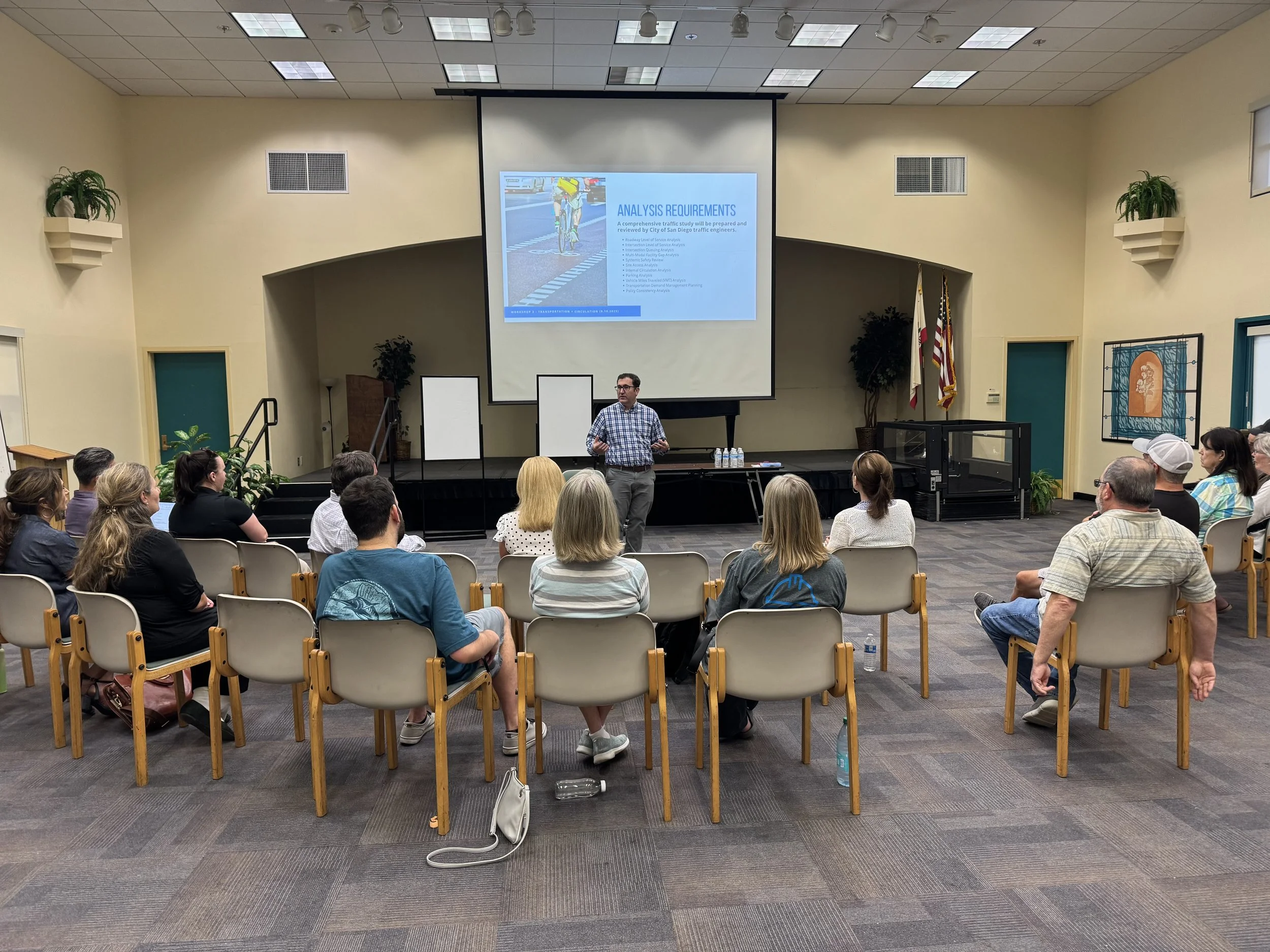
September 10, 2025 | 6:30 - 8:00 p.m.
Scripps Ranch Library
10301 Scripps Lake Dr.
Workshop Objective
Identify community concerns and areas of interest to guide future site planning efforts and technical studies related to vehicular, pedestrian and bicycle circulation and mobility.
Background
In partnership with the Scripps Ranch Planning Group (SRPG) Ad-Hoc Subcommittee, Shea Homes hosted its second workshop pertaining to transportation and circulation for the new collection of homes planned for five vacant parcels located at Scripps Ranch Blvd. and Scripps Lake Blvd.
The discussion was led by project traffic engineer Steve Cook from Intersecting Metrics. Project team members in attendance included: Paul Barnes, Dennis Schroeder, Jordan Selva, Marisa Lundstedt, Arlene Tendick, Marina Wurst.
Welcome
Arlene outlined key milestones and development process (slide 5), including a short overview of the first workshop and community context of the project site (slide 6).
They also explained the thematic meeting approach, highlighting that this session would focus on transportation and circulation. The purpose of the thematic meetings is to allow for deeper conversation into the topics people care most about with the relevant project team members.
Community Plan Alignment
The Scripps Miramar Ranch Community Plan serves as the governing document for the area and its goals and objectives help guide planning for community circulation elements. Throughout the process, Shea has committed to providing clear connections to how the project aligns with the Scripps Miramar Ranch Community Plan (slides 7-8).
Traffic Analysis
Through our conversations with the public, we’ve received feedback on traffic, however the city has specific requirements related to transportation analysis to ensure a comprehensive study and the necessary mitigation is included. The traffic study will be submitted to the city along with the project application (estimated for Q1 2026) and reviewed by the city’s traffic engineers. A list of the required analysis in included as slide 10. After providing this overview, Steve answered questions and took comments from attendees. Feedback was broken into four categories and recorded on large poster boards. The questions and comments from this workshop will help frame how transportation and circulation are looked at for the project.
Vehicular Access
No vehicular access from Canyon Lake
No left turns onto SR Lake
Consider cumulative impacts of other nearby projects
Public v. private streets?
Consider school pick up/drop off traffic on Meanley
Study road diet on SR Blvd.
Study the # of intersections and access
Consider adaptive traffic signals
Evaluate Meanley medians
Parking!
Emergency vehicle circulation
Misc.
Look at impacts to public facilities
Look at homes’ front door orientation - face street or not?
Look at affordable housing within Community Plan area
Pedestrian Access
Consider trail to lake and library
Look at Pharm. plans - culvert + parking
No pedestrian access from Canyon Lake - Dissuade parking in cul-de-sac and walking to lot 6
Study feasibility of pedestrian bridge to SRHS - evaluate impacts to canyon/creek
Bicycle Connectivity
No bike lanes on SR Lake. Dangerous till library
No bollards
Public Transit and Multi-Modal Mobility
Foster/encourage use of public transportation
Understand bus schedule and timing
Summary and Next Steps
The meeting concluded with a review of next steps. Marisa outlined the upcoming phases of the process, noting that the input gathered during this session will directly inform both design concepts and future discussions. Attendees were encouraged to stay engaged as the project moves forward.